Building defects
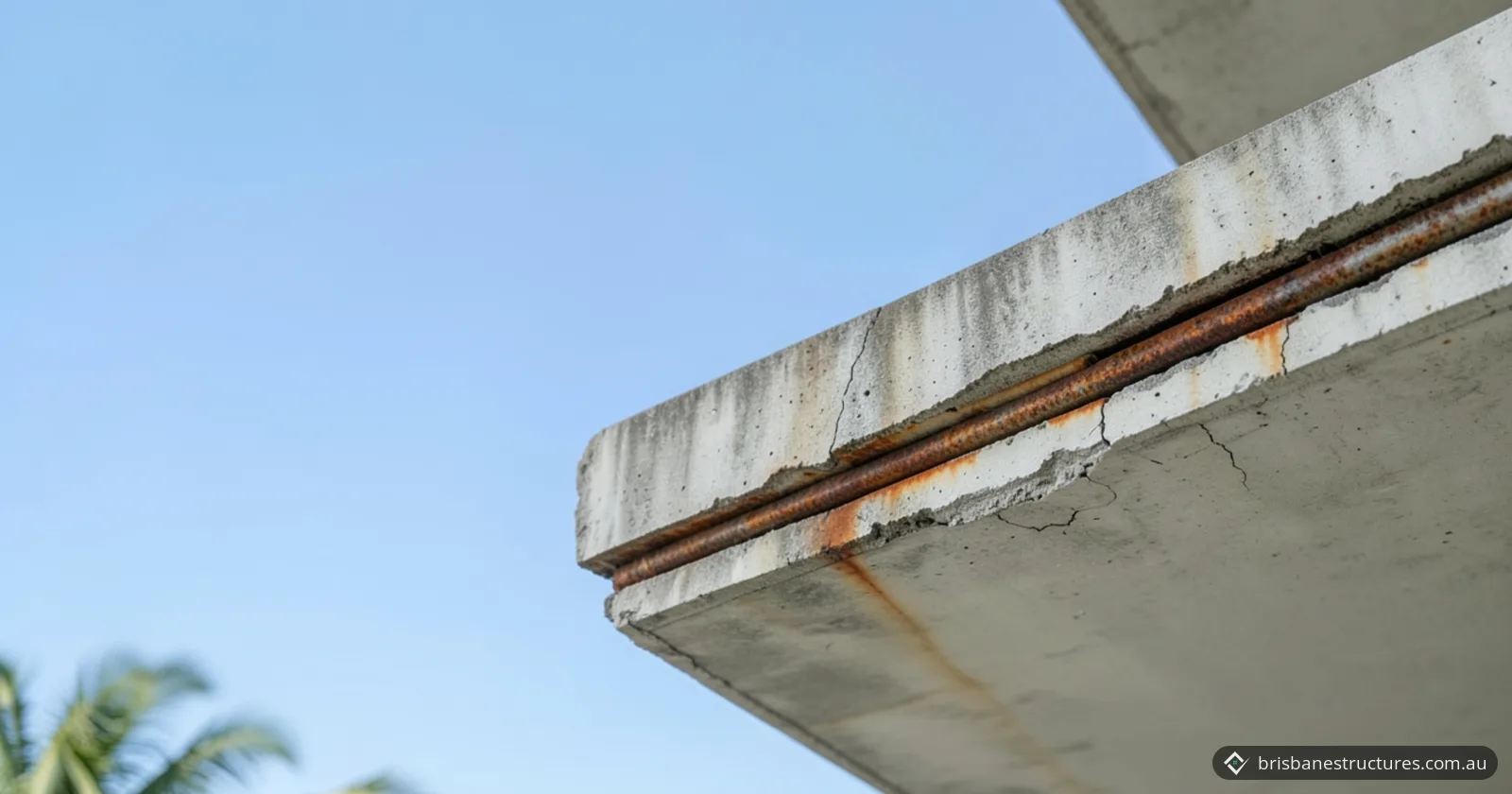
In short: Concrete cancer is concrete that cracks and breaks away because the steel reinforcement inside it is rusting. Rust takes up more room than steel, so it forces the concrete apart. Signs include rust stains, cracks along the steel, hollow-sounding concrete and exposed bars. Repairs usually involve cutting out damaged concrete, cleaning the steel, rebuilding the section and stopping water and salt getting in.
Key takeaways
- Steel in concrete rusts once carbonation or chlorides break down the protective layer that alkaline concrete forms around it.
- In Queensland, chlorides mainly come from salt spray and salt-laden water, and strong winds may carry salt spray several kilometres inland.
- Patching alone can fail: if the conditions for corrosion remain, steel just outside a fresh patch can rust and spall.
- Under a building format plan, the body corporate usually maintains a balcony's structural slab, even when the balcony is part of a lot.
- Queensland home warranty structural claims are due within 3 months of noticing the defect; the scheme excludes blocks over three storeys above a car park.
Seeing rust stains, cracks or loose concrete on a balcony, column or slab? Send photos, with a ruler or coin for scale, through our quote form or call 07 3155 5013.
What is concrete cancer?
Concrete cancer is reinforced concrete cracking and breaking away because the steel inside it is rusting. UNSW Sydney's School of Materials Science and Engineering explains that water may seep in through cracks or pores and react with the steel to form rust. Rust takes up more volume than the steel, so it forces the cracks wider and lets in more water.
Steel in concrete is normally protected. The structures inspection manual of the Queensland Department of Transport and Main Roads (TMR) says alkaline concrete forms a passive film around the reinforcement, and corrosion won't normally start unless that film breaks down.
What are the signs of concrete cancer?
The signs of concrete cancer are rust stains, cracks that follow the steel, concrete that sounds hollow when tapped, and pieces breaking away to expose rusty bars. TMR says corrosion may first appear as rust staining; in advanced stages the cover concrete cracks, delaminates and spalls off.
- Rust stains. Not every stain is concrete cancer: Dulux notes that tie wire and bar chairs near the surface can rust and stain without affecting the structure.
- Cracks along the steel. BRANZ, New Zealand's building research body, says the first outward signs are usually small cracks along the lines of the bars, sometimes with rust stains. Some cracks over bars form while fresh concrete settles (TMR).
- Drummy concrete. Delaminated concrete can look solid but sounds hollow when tapped (TMR).
- Spalling. The cover breaks off, leaving sharp edges and exposed, corroded steel (TMR).
The Queensland Government says a deck or balcony should be inspected carefully for problems including corrosion and cracking of concrete.
What causes concrete cancer?
Concrete cancer is caused by carbonation or chlorides breaking down the steel's protective film, after which water and oxygen drive the rust. TMR says the film typically breaks down only through one of these two, and BRANZ says the rate of corrosion depends on the availability of water and oxygen. TMR, BRANZ and Dulux describe the two processes:
| Carbonation | Chloride attack | |
|---|---|---|
| What happens | Carbon dioxide dissolves in moisture in the concrete's pores and reacts with the cement paste, slowly lowering the alkalinity of the cover | Enough chloride ions can break down the steel's passive layer locally, even while the concrete is still highly alkaline |
| Where it comes from | Carbon dioxide in the atmosphere | In Queensland, mainly salt spray and salt-laden water; also contaminated water or admixtures used when the concrete was made |
| Higher risk | External corners, and poor-quality, permeable concrete | Near the coast, where BRANZ rates the chloride risk significantly higher than carbonation |
| Worth knowing | On its own, carbonation isn't a defect; it sets up the conditions for corrosion | Chlorides can cause pitting that quickly reduces a bar's diameter at one point |
Poor construction makes both worse. Dulux lists faulty specification or design, steel placed too close to the surface, and no anti-carbonation coating; the closer the steel, the sooner carbonation reaches it. Dulux points to AS 3600, the Australian Standard for concrete structures, for the minimum cover for each exposure classification.
Why are coastal and humid parts of Queensland more exposed?
Coastal and estuary sites in Queensland are more exposed because salt spray and salt-laden water carry chlorides into concrete, and warm, moist conditions can speed up corrosion. TMR names salt spray and salt-laden water as the main way chlorides enter concrete in Queensland. In coastal areas and river estuaries, it says tidal flows can bring salt-laden water inland, and strong winds may blow salt spray several kilometres inland.
Business Queensland describes South East Queensland's coastal climate as having warm humid summers. BRANZ says warmer concrete can corrode faster, and moist concrete faster than dry, though fully saturated concrete is often protected by low oxygen. It names cyclic wetting and drying with marine salt spray as the greatest danger.
Water getting into balconies matters too. The Queensland Building and Construction Commission (QBCC) says waterproofing failures are high on its list of common defects, along with poor balcony drainage.
How is concrete cancer repaired?
Concrete cancer is repaired by finding the cause and extent of the damage, cutting out damaged concrete, cleaning the steel, rebuilding the section and protecting it. Standards Australia's SA HB 84:2018, Guide to concrete repair and protection, covers inspection techniques, protective and remedial systems and repair practice. A typical sequence:
- Assess. Tapping finds hollow areas. A pH indicator such as phenolphthalein on freshly broken concrete shows how deep carbonation has reached: carbonated concrete stays clear and the rest turns pink (TMR).
- Break out. Loose concrete is removed. Where steel is corroded, TMR's specification for repairing new concrete (MRTS274) notes the concrete behind the bar may need to be removed so the whole bar can be cleaned.
- Check the steel. Corroded steel resists tension less well (BRANZ), so the loss of steel is checked before the repair is designed.
- Rebuild. The section is reinstated with a repair material, following the manufacturer's instructions in full (Dulux).
- Protect. Dulux says coatings that resist carbonation and chloride ions block carbon dioxide, chlorides and moisture. BRANZ suggests resin injection for dormant cracks and a flexible sealant for non-structural moving ones. Leaks and failed waterproofing are fixed so water stops reaching the steel.
Why can patching concrete cancer fail?
Patching alone can fail when the conditions that caused the rust remain, because a fresh patch can shift corrosion to the steel just outside it. Dulux calls this incipient anode formation, or the ring anode or halo effect, and BRANZ warns that a patch can set up an incipient anode where steel passes from old, low-quality concrete into new, high-quality concrete. The new repair concrete has a higher pH than the old concrete around it, so the steel around the patch becomes the anode, where rust and spalling can occur if the corrosion conditions are still present.
What Queensland rules apply to concrete cancer?
In Queensland, the rules that matter most for concrete cancer are body corporate maintenance duties, QBCC time limits for defective building work, and QBCC licensing.
Bodies corporate and balconies
Under the Body Corporate and Community Management Act 1997 (BCCM Act), a body corporate must maintain common property in a good and structurally sound condition, and an owner must maintain their lot in good condition.
The detail is set by the scheme's survey plan, which shows the lot and common property boundaries, and its regulation module. Under a building format plan, a balcony outside the lot boundaries is usually entirely the body corporate's responsibility. For a balcony that forms part of a lot, the split is:
| Balcony that forms part of a lot | Usually maintained by |
|---|---|
| Structural slab, joists or other supporting framework | Body corporate |
| Balustrades or railings on the boundary | Body corporate |
| Roofing membrane, where the balcony protects lots or common property below | Body corporate |
| Tiles and other non-structural items | Owner |
| Painting inside the balcony; doors and windows leading onto it | Owner |
Defective work and home warranty
QBCC says owners lodge defective work complaints about their own unit, and the body corporate lodges them for common property, after giving the contractor written notice. Complaints about structural defects must be lodged as soon as possible and within 12 months of noticing them, and QBCC can only direct a builder to fix work within 6 years and 6 months of its completion.
The Queensland Home Warranty Scheme generally covers structural defects for 6 years and 6 months from the earliest of paying the premium, signing the contract or work starting (7 years from the contract date if the build takes more than 6 months), if the claim is lodged within 3 months of noticing the defect. It doesn't cover work in and on multiple-unit dwellings of more than three storeys above a car park.
Repair contractors
QBCC treats work valued over $3,300, including labour, materials and GST, as building work, which needs a QBCC licence. Check the contractor's licence on the QBCC register before work starts.
When to call a structural engineer
Call a structural engineer when concrete is cracking along the steel, sounds hollow, has broken away or shows rusty bars, and before anyone quotes a repair. BRANZ advises getting specialist advice before repairing concrete with corroded steel, and says repairs are easier and cheaper when the damage is first noticed. Book an inspection if:
- concrete has broken away from a balcony, column, beam or slab underside;
- rust stains come with cracks along the steel, edges or corners;
- an earlier patch is cracking or rusting at its edges;
- the body corporate needs a repair scope, or the work is recent enough for a QBCC complaint or warranty claim.
Our structural inspections assess steel corrosion, section loss and slab cracking, and rate each defect's severity with recommended actions. For a QBCC complaint, a building defect structural report documents the problem. Our engineering services also include building remediation design and advice, and strata reports.
Frequently asked questions
Is concrete cancer dangerous?
It can become dangerous. BRANZ, New Zealand's building research body, notes that in serious cases, corrosion cracking can lead to severe spalling that may end in structural failure. Once the steel is fully exposed, BRANZ says its corrosion rate increases rapidly.
Why does concrete cancer take years to appear?
Carbonation is slow. Queensland's Department of Transport and Main Roads (TMR) describes it lowering the alkalinity of the cover over a long period, and BRANZ says that with an adequate thickness of well-compacted, low-permeability concrete, carbonation can take many decades to reach the steel in good-quality concrete.
Does every crack in concrete mean concrete cancer?
No. TMR lists drying shrinkage, steel corrosion, alkali-aggregate reaction, applied loads, restraint and settlement among the causes of cracking in hardened concrete, and says a key factor is whether a crack is stable or still growing.
Can concrete cancer affect a house slab?
It can, but BRANZ notes that corrosion of steel in dry interior concrete is unlikely. It lists soil water with high chloride levels as one source of chlorides.
Sources
- Queensland Department of Transport and Main Roads: Structures Inspection Manual, Part 2: Deterioration Mechanisms (2016)
- Queensland Department of Transport and Main Roads: MRTS274 Repair of New Concrete Construction (2024)
- Queensland Government: Inspecting decks and balconies
- Queensland Government: Body corporate maintenance responsibilities
- Queensland Government: Building format plan and building units plan maintenance
- Business Queensland: Building in Queensland's climate zones
- QBCC: Help with defective work
- QBCC: What is the Queensland Home Warranty Scheme?
- QBCC: Building work
- QBCC: Value of building work
- QBCC: QBCC's guide to apartment renovations and avoiding costly mistakes
- Standards Australia: SA HB 84:2018, Guide to concrete repair and protection
- Standards Australia: AS 3600:2018, Concrete structures
- Dulux Protective Coatings: Tech Note 1.3.6, Concrete spalling (2026)
- UNSW Sydney, School of Materials Science and Engineering: Concrete cancer
- BRANZ (New Zealand): Bulletin 574, Preventing corrosion of reinforcing steel in concrete (2014)